

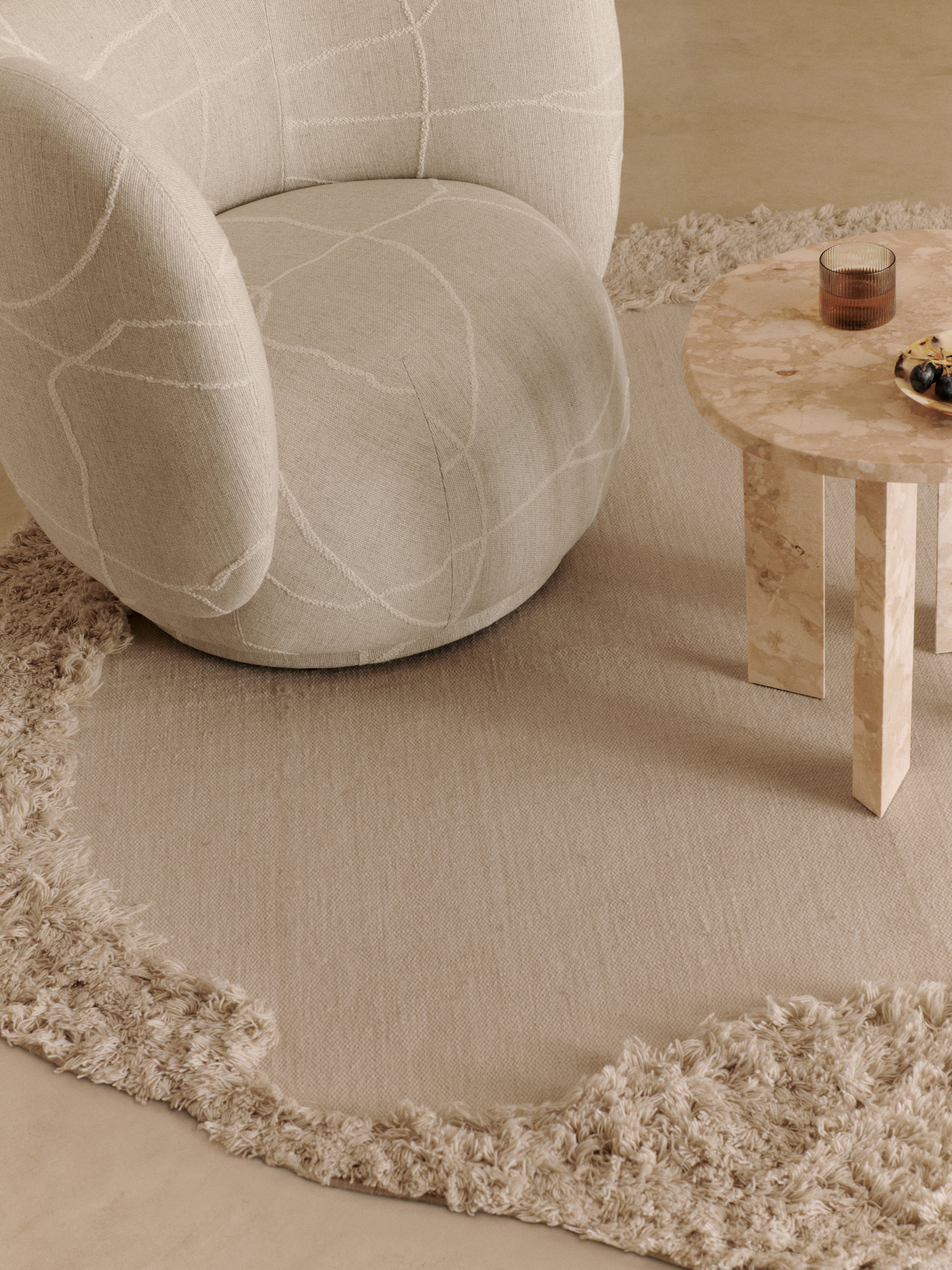

In recent years, the Scandinavian style has become one of the most popular interior design trends. Its popularity is primarily due to its simplicity, coziness, and functionality. However, when deciding to furnish a home in the Scandinavian style, it is important to remember a few principles to guide you during the interior arrangement.
1 - The Origins of Scandinavian Style
As one might easily guess, Scandinavian style originates from the northern part of Europe. It is in countries like Norway, Sweden, and Denmark that outstanding designers decided to combine comfort with elegance, creating one of the most admired and, consequently, most frequently used interior design styles. It is worth emphasizing that the way Scandinavians arrange their interiors is directly connected to their lifestyle and approach to the surrounding world.
The Scandinavians follow the Hygge philosophy, which loosely translates to "coziness" and comfort.
The beige sofa upholstered in corduroy will fit perfectly in a Scandinavian-style living room.

Hygge is called the philosophy of happiness because those who live in accordance with this concept strive to celebrate every moment. Hygge is directly connected to the so-called work-life balance, which involves planning time appropriately so that work does not constitute the main part of life but is an integral part of it.
The Danes, the nation responsible for creating the Hygge philosophy, emphasize that it is a multidimensional word that can have different meanings depending on the approach and context. When it comes to interior design in line with this concept, it is important to highlight the significant role of a calm atmosphere, intimacy, and comfortable finishes, all aimed at bringing residents into a state of relaxation and unwinding. To achieve this, it is worthwhile to focus on pleasant textures and accessories like candles that will warm the entire room. Thus, it can be stated that the designers responsible for creating this aesthetic were merely responding to the needs of the inhabitants.

Green, glass candlesticks from the HKliving collection complement the Scandinavian-style dining room.
2 - Creators of Scandinavian Style
Among the most popular designers responsible for promoting and spreading Scandinavian style in Europe and around the world are Hans Wegner and Arne Jacobsen.
Hans Wegner, who was one of the main creators of Danish modernism, began his design career at the age of 14. It was then that he started training under master carpenter H. F. Stahlberg. It quickly became apparent that young Wegner had a unique talent for working with wood — perhaps his work with Stahlberg influenced his later passion for this material.

Wegner almost throughout his life repeated that he aimed to create the simplest and most functional constructions based on the beauty of natural materials. His main principles include: simplifying forms, limiting broadly understood decorations, and introducing the so-called process of interior cleansing.
Interestingly, Hans Wegner is best known for the chairs he designed. Throughout his life, he created over 500 chair designs that continue to captivate world-renowned designers with their form. Today, Wegner's works can be seen, among others, at the Museum of Modern Art in New York or at Designmuseum Danmark in Copenhagen.
3 - Types of Scandinavian Style
Although Scandinavian style is incredibly popular (especially in Europe), few people realize that there are several distinct types. This diversity primarily arises from the different needs of each community (after all, Scandinavia comprises three countries). Despite many similarities and shared features, one can easily notice characteristic elements that appear exclusively in specific interior design approaches.

Danish Style
The most popular and commonly encountered type of Scandinavian style is Danish stylethat we mentioned earlier while discussing the work of Hans Wegner. The Danish style is characterized by maximum simplicity. All decor elements in the Danish style are very thoughtfully designed and functional. Additionally, it should be noted that furniture and accessories in the spirit of Danish minimalism also feature extraordinary design and excellent quality.
At this point, it is worth emphasizing the immense role of quality, as it is the essence of Danish style. By using high-quality materials, furniture will look great even after many years and fulfill its purpose.
Danish minimalism has become a symbol of functionalism, excellent design, and exceptional precision.
Danish style table. It features a distinctive wooden texture and a natural finish that reflects the lifestyle of the Danes.

Dark Nordic style
The next type of Scandinavian style that deserves attention is the so-called dark nordicwhich, unlike the classic Danish style based on a light color palette, is characterized by the presence of black, navy blue, and dark shades of gray. Despite these innovations, all elements in this style maintain color consistency, and the materials used to produce furniture in this aesthetic are of natural origin.
Furniture constructions in the dark nordic style are most often made of wood.
Black sideboard designed in the dark nordic style. It is made of high-quality oak wood and stainless steel.

Japandi style
Although style Japandiis a kind of hybrid, a combination of two styles, and we believe it is worth mentioning. First and foremost, it should be noted that it is a contemporary variation of the Scandinavian style, based on its key principles such as:
- Consistency,
- Simplicity,
- Order,
- Natural materials,
- High quality.
Interior design trends change very quickly, however, when it comes to Scandinavian style and its branches, one can theorize that it belongs to classic solutions that periodically return in completely new or traditional forms. This is due to universal patterns that work perfectly in almost every corner of the world.
To arrange an interior in Japandi style, choose furniture that is minimalist in form, without curved legs or patterned fronts. It's also worth paying attention to elements with rounded shapes and smooth fronts. Opt for upholstery without quilting and stitching.
In Japandi style, furniture in wood tones or white works best.
White armchairs upholstered in boucle fabric in Japandi style

Scandi boho style
Similar to Japandi, scandi boho is also a blend of two styles. This branch of Scandinavian style is characterized by a muted color palette, minimalist shapes, and the use of natural materials (both in furniture and accessories) such as wood, wicker, linen, cotton, rattan, or jute.
When planning a scandi boho interior, it's also worth ensuring the presence of plants and botanical motifs.
Designer wardrobe in scandi boho style

4 - How to arrange an interior in Scandinavian style?
After reading this article, you are surely well aware of the characteristics of Scandinavian style, now it's time for practical tips that will help your home perfectly fit into this specific aesthetic.
Colors in Scandinavian Style
The first step towards a Scandinavian-style home is to remember that its main goal is to adapt to the needs of its inhabitants. Scandinavia is a region characterized by polar nights and days, which means that the local community often has to deal with a lack of sunlight and vitamin D.
This is mainly why the interiors of homes decorated in the Scandinavian style are usually kept in light colors. Among the most commonly mentioned colors associated with the Scandinavian style are traditional whites, beiges (in various shades), and grays.

Convertible sofa in beige will perfectly complement a Scandinavian living room
Natural materials of furniture and accessories
The inhabitants of the Scandinavian Peninsula also value contact with nature, which is why their homes are filled with furniture made from materials such as wood or stone. It is also important to remember about accessories: when choosing textiles for the home, opt for products made from cotton, linen, or wool. Interestingly, both Swedes, Norwegians, and Danes pay great attention to tableware. Dinnerware is most often ceramic, and its design makes functional items decorative as well.

Rattan chair is perfect for the living room or bedroom
Functionality and comfort above all
When it comes to dining room furnishings, it is also worth emphasizing that both dining room, as well as kitchen are practical spaces, so when planning them, it is essential to focus primarily on functionality and maximum comfort. Scandinavia is a place where caring for the natural environment is a significant part of daily life, which is why recycling, as well as furniture or decorations made from reclaimed materials, are very popular. However, people living in these areas usually choose high-quality products that serve them for several years.

Stunning table made of sungkai wood in a Scandinavian dining room
We hope that this article has helped you understand the origins of the Scandinavian style, its characteristics, and what to consider when decorating a space in this style. If you need more inspiration, we invite you to explore our Scandinavian collection.


